In small-molecule development, risk rarely appears as a single obvious event. It usually emerges through an atypical analytical result that cannot be defended, a stability trend that forces reformulation, a tech transfer that loses process intent, or an HPAPI handling gap that creates downtime and quality disruption. Under GMP, risk control is not a slogan. It is a practical system of evidence, behaviours, and facility design that protects patients, approvals, and supply continuity.
At Adragos Pharma, that system is built around two connected capabilities. The first is a GMP analytical laboratory that turns rapid development work into defensible GMP data. The second is a dedicated HPAPI containment suite in Athens, supported by defined protocols and trained operators, to help protect people, product quality, and site performance.
Why risk control matters in small-molecule development
Many development delays are not caused by chemistry alone. They are caused by weak interfaces between development, analytics, quality, regulatory planning, and transfer execution. When those interfaces are not controlled early, programmes absorb avoidable delays later through repeated investigations, unstable methods, documentation gaps, and poorly managed hand-offs.
A more reliable model is to build control into the programme from the outset. That means generating data that can support real decisions, defining responsibilities clearly, and ensuring facility design supports safe and disciplined execution. In practice, this is what reduces late-stage surprises.
A site model built for speed, GMP discipline, and cross-functional delivery
Our Athens facility is structured to balance pace with GMP discipline. Development work can move quickly in R&D laboratories, while activities that require GMP-grade evidence are supported by a fully GMP analytical laboratory. Quality management, supply chain and procurement, and the wider scientific team work in close proximity to day-to-day execution. This helps keep quality thinking embedded in delivery rather than added later.
That proximity matters because many programme failures are interface failures rather than science failures. Requirements are assumed rather than documented. Ownership is unclear. Critical details appear too late. A site model that keeps development, analytics, and quality closely connected helps reduce those avoidable gaps and supports faster, better-informed decisions.
How a GMP analytical laboratory supports better development decisions
Sponsors often think of analytics as testing. In practice, a GMP analytical laboratory provides the evidence base for release decisions, stability interpretation, comparability, investigation outcomes, and transfer readiness. If a method is not robust, controlled, and properly documented, it cannot support those decisions with confidence.
At Adragos Pharma, we use a practical model that preserves development speed without compromising compliance. Methods are developed in R&D so that early work can progress efficiently, then transferred internally through analytical method transfer to GMP so that the method becomes suitable for GMP use. This allows development to remain agile while ensuring that the data used for key programme decisions are generated under the right controls.
Our GMP analytical laboratory operates within full GMP systems, including disciplined documentation, structured checks, and clear oversight of who is qualified to perform each activity and how that work is verified. This is important because analytical control is not only about instrumentation. It is about whether the data can stand up to internal scrutiny, external audit, and regulatory review.
Why analytical method transfer to GMP reduces late-stage risk
Analytical method transfer to GMP is not an administrative step. It is a practical way to reduce risk in the areas where development programmes often fail late.
Data integrity ALCOA+ and traceability
Moving methods into a GMP environment strengthens documentation discipline, traceability, and execution control. This supports data integrity ALCOA+ expectations by making datasets more attributable, legible, contemporaneous, original, accurate, and complete. For sponsors, that matters because the value of an analytical result depends on whether it can be trusted, reconstructed, and defended when needed.
Faster investigations and fewer surprises during pivotal work
When pivotal activities such as stability studies, process support, or validation-related work begin, an established GMP analytical framework reduces disruption. The method has already moved into a more controlled environment, which makes it easier to identify root causes, compare results over time, and investigate atypical findings with greater confidence.
Internal transfer also reduces hand-off friction. Instead of trying to rebuild analytical control during scale-up, the programme has already established how it will generate reliable evidence under GMP conditions.
FDA inspection readiness starts with daily GMP behaviour
Regulatory expectations often become more demanding as a programme advances. A project that begins with one target market may later need to support US-facing requirements. When that happens, readiness gaps become expensive.
At Adragos Pharma, the GMP analytical laboratory supports project-specific audit and preparedness activities without requiring a complete reset. In practical terms, FDA inspection readiness begins with daily behaviour. It is reflected in controlled execution, documented review, training discipline, and consistent quality oversight. That approach helps reduce the risk of last-minute remediation when regulatory expectations increase.
How an HPAPI containment suite protects people, quality, and timelines
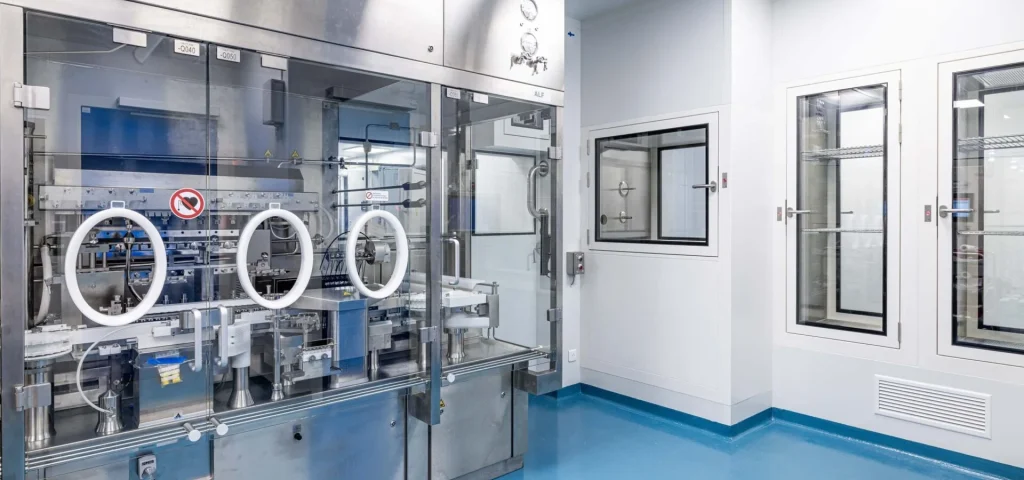
Highly potent APIs are still synthetic small molecules, but the operating model is more demanding. The main complexity is not always the chemistry itself. It is the need for strict containment, disciplined HSE practices, and robust controls that prevent exposure and cross-contamination while allowing the programme to continue moving. At our Athens facility, this is addressed through a dedicated HPAPI containment suite supported by defined protocols and a trained-operator model. Access is restricted to trained personnel. The set-up includes specialised protective equipment and established handling processes designed to minimise exposure risk. Material movement is controlled through a decontamination pass-through arrangement rather than standard door-based movement. This supports safer execution and stronger control over contamination pathways.
Containment as a system, not an add-on
HPAPI programmes become vulnerable when containment is treated as an isolated engineering feature rather than an operating system. A dedicated suite, trained personnel, controlled access, and defined handling practices work together to reduce execution variability and support safer routine operations.
This improves operational predictability by lowering the likelihood of delays linked to safety or contamination events. It also helps protect the wider site by reducing the risk that high-potency work affects adjacent activities.
Contamination control strategy for HPAPI programmes
A strong contamination control strategy for HPAPI work depends on more than physical segregation. It requires consistent operator behaviour, defined material flows, appropriate protective measures, and analytical thinking that supports trace-level expectations where needed.
For that reason, HPAPI containment is closely connected to analytical capability. High-potency programmes often require methods and cleaning approaches that support confidence at very low levels. In operational terms, containment protects people, but it also protects timelines, product quality, and broader site performance.
De-risking development before the first batch
A large share of development risk is created before experimental work begins. If scope is incomplete, or if clinical and regulatory assumptions are not considered early, programmes discover critical requirements late and pay for them twice.
At Adragos Pharma, feasibility and pre-binding offer work is designed to be cross-functional. R&D formulation, GMP analytics, regulatory, quality, and clinical or bioequivalence-related input contribute in parallel so that hidden requirements are surfaced while the plan is still flexible. This is where a Quality by Design mindset becomes practical. We assume variability exists, identify what is most likely to matter for patient safety and product performance, and build proportionate controls into the development plan from the start.
Where specialist external studies are appropriate, the priority is to avoid fragmented accountability. The objective is to keep the sponsor interface simple, maintain one accountable project lead, and ensure one integrated dataset and one coherent dossier narrative. That reduces the risk of inconsistent data packages, unowned deviations, and timeline slippage caused by weak interfaces.
Tech transfer support that protects process intent
Risk control does not end when development activity is complete. Tech transfer is one of the points where process intent can be lost, especially when a third-party manufacturing site receives the process.
At Adragos Pharma, tech transfer is treated as an engineered activity rather than a simple hand-off. Practical support through the transfer cycle helps the receiving site understand not only what the process is, but why critical controls exist and what cannot be changed without consequence. That continuity helps reduce avoidable deviation cycles during scale-up and early manufacturing.
De-risking small-molecule development is not about removing uncertainty completely. It is about building a disciplined system that identifies uncertainty early, turns it into evidence, and supports decisions that protect patients and programme value. At Adragos Pharma, our Athens facility brings together GMP analytical laboratory capability, analytical method transfer to GMP, and a dedicated HPAPI containment suite within a cross-functional operating model that helps sponsors move from development into clinical and commercial manufacturing with fewer avoidable surprises.
