When an injectable solution is administered, it bypasses the patient’s normal protective barriers. Skin and the digestive system no longer act as filters. At that point, the primary packaging becomes the barrier. That is the starting point for any sterility assurance strategy: we are not simply aiming for “sterile”. We are aiming to protect the patient from systemic harm at the moment they are most exposed.
For terminally sterilised ampoules, this mission translates into three non-negotiable quality outcomes, with a fourth constraint that is often underappreciated:
- Sterility: absence of viable microorganisms.
- Apyrogenicity: control of endotoxins and the risk of pyrogenic reactions.
- Absence of particulates: with a particular focus on glass-related particulates in ampoule processes.
- Stability of the solution: at release and through shelf life, acknowledging that abnormal thermal exposure can drive degradation and impurity formation.
Why terminal sterilisation is preferred when the product can tolerate it
Terminal sterilisation remains the preferred approach whenever the formulation can withstand it, because it is inherently more robust than relying solely on aseptic processing controls. In aseptic manufacture, sterile filtration can make the solution sterile, but the moment the solution is introduced into the container, the process becomes vulnerable to contamination events driven by interventions, equipment interfaces, and human factors. With terminal sterilisation, the lethality of the cycle provides an additional barrier, provided that upstream risks are controlled with discipline, especially endotoxins.
This distinction matters because terminal sterilisation does not eliminate the endotoxin question. A microorganism can be inactivated, but endotoxins can remain and still drive fever or pyrogenic shock. That is why endotoxins remain a specification at batch release. The acceptance limit is justified in the marketing authorisation dossier and is based on factors such as product concentration and patient-related assumptions (including age, where relevant).
Ampoule-specific risks: glass, breakage, and what you cannot see
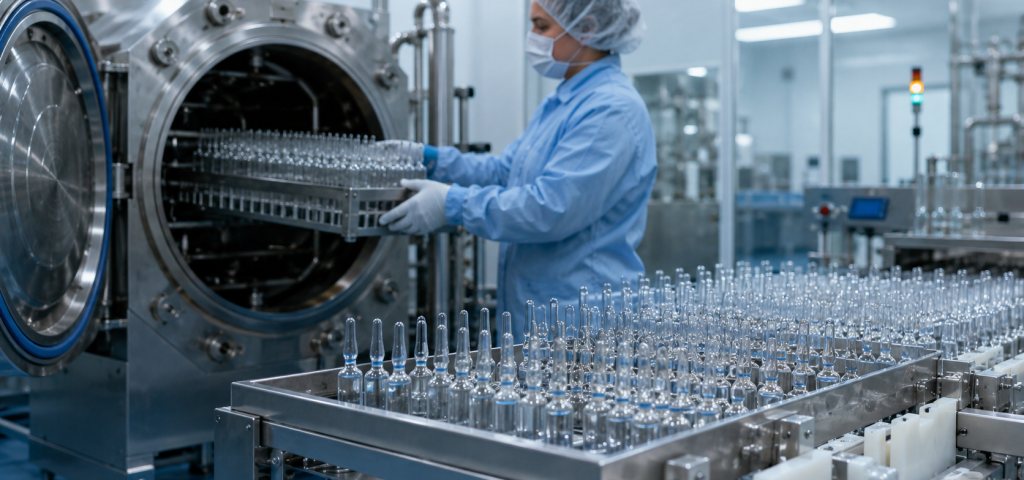
Ampoules bring a practical reality: glass is always present, and glass-related risks are not theoretical. In a typical process, open-neck ampoules are received, washed to remove particulate contamination, then passed through a depyrogenation tunnel to destroy endotoxins potentially present on the container. From there, the ampoules move under laminar flow to filling.
The glass risk is rarely the container itself. It is the mechanics of the line. Ampoules move, vibrate, and can break. The operational response is not to claim “zero breakage”, but to design a layered control strategy: in-line breakage detection (for example, cameras installed at key points), clear procedures for managing breakage events and isolating potentially impacted units, and then robust downstream inspection.
Inspection is not only about pass or fail. Automatic visual inspection at 100 percent enables segregation of conforming and non-conforming units. Reviewing a statistical sample of rejected units and trending the types of defects (including glass particulates) provides an early warning system. It supports continuous improvement, rather than waiting for a critical deviation to force learning.
Then comes the most insidious risk: post-contamination through loss of container closure integrity after sealing. You can control the solution. You can wash and depyrogenate the container. You can fill and seal. But if sealing is defective, microorganisms can enter later. This is where 100 percent leak detection becomes pivotal.
One approach for the CCIT (Container Closure Integrity Testing) is HVLD (High Voltage Leak Detection). The ampoule moves through the system, the solution distributes along the body and headspace, a high-voltage signal is applied and measured, and micro-leaks or micro-cracks change the electrical response because the liquid conducts differently. This can identify defects that are not visible during routine handling, yet are meaningful for sterility assurance.
Cycle definition, validation, and evidence: what makes terminal sterilisation credible
Terminal sterilisation is only as strong as the evidence behind it. Operationally, this starts with a defined reference cycle. The interview referenced a typical steam sterilisation baseline (autoclave), with 121 °C used as a reference point and a defined holding time, with adaptations possible depending on the product and the target lethality.
Autoclave qualification and ongoing assurance rely on demonstration, not assumptions. Key elements include:
- Temperature probes placed across the load, including locations such as the drain and representative positions in the chamber.
- Biological indicators used in parallel during validation to confirm lethality challenge.
- Representative formats, including extreme sizes and a mid-range format, repeated on a defined cadence (for example, annually).
Two “shop-floor” topics deserve particular attention.
1) Holding time between sealing and sterilisation. Once the ampoule is filled and sealed, the allowable time before autoclaving must be validated and controlled. An example described a validated maximum holding time of 56 hours, supported by bioburden testing at time zero and again beyond the limit, demonstrating no increase in microbial load. In routine execution, pallets are labelled with end-of-fill time and a hard deadline for autoclaving. The control is operational, not merely a statement in a protocol.
2) Product variability and a pragmatic “family” approach. When a site manufactures many products, full product-by-product qualification can become disproportionate. A scientifically grounded alternative is to group products into families using a parameter that materially affects heat transfer. Density was cited as critical, because higher-density solutions can show delayed heat-up behaviour inside the ampoule. New products are assessed against a matrix to determine whether they fit an existing family or require a specific qualification exercise. This approach must be justified rigorously, particularly in inspection discussions.
The human factor: the risk that never fully disappears
Even with validated cycles, qualified utilities (including water and steam), and automated controls, the human factor remains a primary risk driver for the product contamination. Shift patterns, staff turnover, the burden of gowning, and simple realities such as illness all create variability that must be actively managed.
Two practical practices stand out:
- Maintain periodic simulation exercises even on terminal sterilisation lines. While not a regulatory requirement in the same way as for aseptic processing, these exercises help confirm discipline, reinforce behaviours, and keep teams inspection-ready.
- Use video review as a learning and investigation tool, triggered by events such as environmental anomalies. The value is in objective reconstruction and targeted improvement. The governance matters: clear alignment with workforce representatives, transparent rules on when footage is reviewed, and a shared understanding that the purpose is patient protection and reduction of batch loss, not surveillance.
Closing thought
Terminal sterilisation provides powerful risk reduction, but it is not “just an autoclave cycle”. Real sterility assurance in terminally sterilised ampoules is built from disciplined upstream control of endotoxins and bioburden, validated and operationally enforced holding times, scientifically justified qualification strategies (including family approaches), robust management of glass and particulate risks, and, critically, container closure integrity controls that can detect micro-defects at 100 percent inspection rates.