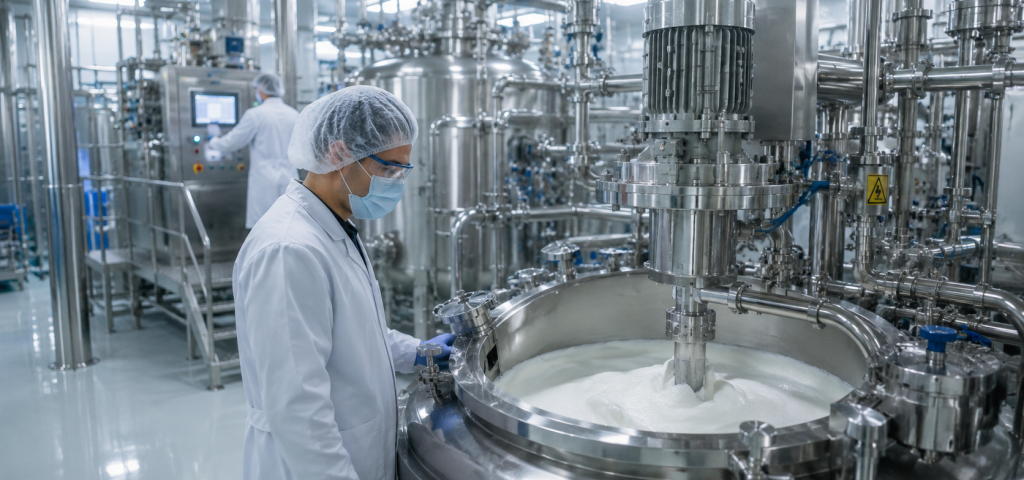
Semisolid technology transfer to a European Contract Development and Manufacturing Organisation is the structured process of migrating an established or in-development topical pharmaceutical formulation from a source site to a receiving manufacturing facility. The transfer is designed to maintain full product quality, process reproducibility and regulatory compliance throughout. It covers analytical method transfer, process documentation review, equipment comparability, pilot batch manufacturing and the establishment of a compliant quality system at the receiving site.
For development leaders evaluating pharmaceutical outsourcing in Europe, understanding each component of this process is essential before selecting a manufacturing partner.
Why Semisolid Formulations Require a Dedicated Transfer Strategy
Semisolid dosage forms, including creams, gels, ointments and healing pastes, present distinct technical challenges that differentiate their technology transfer from other pharmaceutical forms. Unlike solid oral dosage forms, semisolids are highly sensitive to processing parameters including heating and cooling rates, homogenisation intensity, mixing time and deaeration conditions. Small deviations in these parameters can alter product viscosity, particle size distribution, emulsion stability or microbial control, all of which carry direct implications for patient safety and regulatory acceptability.
Additionally, the rheological behaviour of semisolid products is equipment-dependent. A formulation optimised on one manufacturer’s homogeniser may behave differently on a non-equivalent system at the receiving site. This means equipment characterisation and comparability studies are not optional stages in a semisolid transfer. They are foundational requirements.
The Core Stages of a Semisolid Technology Transfer
A compliant technology transfer to a European Contract Development and Manufacturing Organisation follows a defined sequence. Each stage builds upon the outputs of the previous one.
Stage 1: Technical Feasibility Assessment
Before any transfer agreement is formalised, the receiving site assesses the technical feasibility of manufacturing the target formulation within its existing infrastructure. This includes evaluating batch size compatibility, equipment suitability, raw material sourcing, containment requirements and any controlled substance handling obligations.
At Adragos Leipzig, this feasibility stage draws on over 100 years of manufacturing experience across semisolid and non-sterile liquid dosage forms, supporting an honest and rapid evaluation of fit.
Stage 2: Transfer Package Review and Knowledge Capture
The transfer package submitted by the originating organisation should contain the following at minimum:
- The master batch formula and manufacturing process description
- In-process control specifications and acceptance criteria
- Finished product specifications and analytical methods
- Historical batch manufacturing records and batch analysis data
- Stability data and packaging compatibility studies
- Cleaning validation documentation
- A list of critical quality attributes and critical process parameters
This documentation is reviewed in full by the receiving site’s technical team. Gaps are identified, and a gap analysis report is produced before any laboratory or production activity commences.
Stage 3: Analytical Method Transfer
Each analytical method used to test the product must be formally transferred to the receiving site’s quality control laboratory. This process follows internationally recognised validation principles and includes suitability testing to demonstrate that the method performs equivalently in the new laboratory environment.
Methods typically transferred for semisolid products include high-performance liquid chromatography assay and related substances methods, microbiological testing including total aerobic microbial count and total yeast and mould count, viscosity and rheological testing, pH determination and preservative efficacy testing.
At Adragos Leipzig, analytical capabilities include high-performance liquid chromatography, gas chromatography, gas chromatography with headspace analysis, ultraviolet-visible spectrophotometry and titration, alongside microbiology testing for non-sterile products.
Stage 4: Process Development and Scale-Up
Where the formulation requires adaptation to the receiving site’s equipment or infrastructure, a galenical development phase is incorporated. This may involve recipe optimisation, adjustment of mixing parameters or the redesign of manufacturing steps to reflect the receiving site’s equipment train.
Pilot batches are then produced to confirm process performance at the intended commercial scale. At Adragos Leipzig, batch sizes for semisolid manufacturing range from 15 litres to 1,250 litres, allowing meaningful scale-up evaluation across a broad range of product volumes.
Stage 5: Validation and Registration Batch Manufacturing
Following successful pilot manufacturing, validation batches are produced in accordance with European Union Good Manufacturing Practice requirements, specifically under the qualification and validation framework set out in Annex 15 of the European Union Guidelines to Good Manufacturing Practice. These batches are used to demonstrate process consistency, support shelf-life claims and, where required, form part of a regulatory submission dossier.
A Qualified Person at the receiving site certifies each batch prior to release, confirming compliance with the applicable marketing authorisation and national regulatory requirements.
Stage 6: Ongoing Stability and Post-Transfer Review
Following the completion of validation batches, stability studies are initiated or continued under International Council for Harmonisation of Technical Requirements for Pharmaceuticals for Human Use conditions appropriate to the target markets. Product quality reviews are conducted at defined intervals to monitor process consistency over time.
Good Manufacturing Practice Alignment in European Semisolid Manufacturing
European Contract Development and Manufacturing Organisations operating within the European Union are subject to European Union Good Manufacturing Practice, as published by the European Commission and enforced by national competent authorities. Compliance with this framework governs every aspect of semisolid manufacturing, from premises and equipment qualification through to batch release and record-keeping.
For semisolid products specifically, European Union Good Manufacturing Practice requirements relevant to the technology transfer include:
- Premises design to prevent cross-contamination between semisolid product classes
- Equipment cleaning validation to demonstrate removal of active pharmaceutical ingredient and excipient residues between campaigns
- Environmental monitoring for non-sterile controlled manufacturing areas
- Batch documentation integrity and audit trail requirements
- Serialisation in accordance with the EU Falsified Medicines Directive
Adragos Leipzig holds European Union Good Manufacturing Practice certification for both human and animal pharmaceutical products, covering the full range of semisolid and non-sterile liquid dosage forms manufactured at the site.
Risk Management Throughout the Transfer
A semisolid technology transfer introduces defined risk categories that must be assessed and controlled before, during and after the transfer process. These include:
Raw material variability: Differences in excipient sources or grades between the originating site and the receiving site can affect product performance. A raw material comparability study should be conducted as part of the transfer.
Equipment non-equivalence: Differences in homogeniser type, shear profile, vessel geometry or heating and cooling capacity can influence critical quality attributes. Equipment impact assessments are standard practice.
Personnel and knowledge continuity: Technical knowledge held by individuals at the originating site must be captured systematically and transferred in documented form, not assumed to transfer informally.
Regulatory risk: Any change in manufacturing site for a licensed product requires a variation submission to the relevant regulatory authority. The classification of the variation determines the timeline for approval. This should be incorporated into the project plan from the outset.
Selecting a European CDMO for Semisolid Technology Transfer
When evaluating a European Contract Development and Manufacturing Organisation for a semisolid technology transfer, development leaders should assess the following factors:
Demonstrated semisolid manufacturing history: Experience with the specific dosage form classes relevant to the asset in question reduces risk during scale-up and validation.
Analytical laboratory capability: The receiving site must be able to support full method transfer and ongoing quality control testing without reliance on third-party laboratories for routine release testing.
Regulatory standing: A current and uninterrupted Good Manufacturing Practice certificate from a recognised European regulatory authority is non-negotiable. Previous inspection outcomes provide additional assurance.
Batch size flexibility: A site that can accommodate small pilot batches as well as larger commercial volumes allows a progressive scale-up approach without changing manufacturing partners mid-project.
Stability and post-transfer support: Long-term product stewardship, including stability programme management and product quality review, reduces the administrative burden on the transferring organisation.
Semisolid Technology Transfer at Adragos Leipzig
Adragos Leipzig is a European Union Good Manufacturing Practice-certified manufacturing facility in eastern Germany with over 100 years of experience in semisolid and non-sterile liquid pharmaceutical production. The site operates two dedicated semisolid production lines using Marchesini and Norden equipment, with batch sizes ranging from 15 litres to 1,250 litres.
Primary packaging formats for semisolid products at Adragos Leipzig include laminate tubes and plastic tubes from 25 grams to 200 grams, and aluminium tubes from 2 grams to 150 grams. The site is also equipped to handle controlled substances, expanding its suitability for a broader range of therapeutic product categories.
Technology transfer services at Adragos Leipzig span the full scope of the process described above:
- Galenical development and transfer management
- Pilot batch production
- Worldwide raw material procurement
- Commercial manufacturing and primary packaging
- Analytical testing, batch release and analytical method transfer
- Stability studies and contract analysis under International Council for Harmonisation climate zones II, IVa and IVb
- Cleaning and process validation
- Product quality review creation
- Batch certification by a Qualified Person
- Serialisation in accordance with the European Union Falsified Medicines Directive
The site’s manufacturing area covers 13,300 square metres, and the team combines established process knowledge with a documented track record in semisolid and non-sterile liquid contract manufacturing. As part of the broader Adragos Pharma global network, Leipzig clients also benefit from access to complementary drug development services at the Athens facility in Greece and sterile fill-finish capabilities across the Adragos Sterile Cluster in France and Switzerland.
Frequently Asked Questions
What documents are required to initiate a semisolid technology transfer?
A technology transfer typically requires a master batch formula, manufacturing process description, in-process control specifications, finished product specifications, analytical methods, historical batch data, stability data and cleaning validation documentation. The receiving site will conduct a gap analysis to identify any missing elements before transfer activities begin.
How long does a semisolid technology transfer to a European CDMO take?
Transfer timelines vary depending on product complexity, the completeness of the technology transfer package provided by the sending organisation and the regulatory pathway required. Simple non-sterile semisolid transfers with a well-documented history can progress efficiently; products requiring a regulatory variation submission will need to account for authority review timelines in addition to site activities.
Is a regulatory submission required when changing the manufacturing site for a semisolid product?
Yes. Any change of manufacturing site for a product that holds a marketing authorisation in a European Union member state requires notification to the relevant national competent authority. The type of variation required depends on the nature of the change and the specific regulatory framework applicable to the product.
What Good Manufacturing Practice standards apply to semisolid manufacturing in Europe?
European Union Good Manufacturing Practice, as set out by the European Commission, applies to all medicinal product manufacturing within the European Economic Area. For semisolid products, relevant provisions include premises and equipment requirements, process validation under Annex 15 and quality system requirements under Chapter 1.
What semisolid dosage forms can be transferred to Adragos Leipzig?
Adragos Leipzig is equipped to receive technology transfers for creams, gels, ointments and healing pastes. The site operates two dedicated semisolid production lines using Marchesini and Norden equipment, with batch sizes from 15 litres to 1,250 litres, and is capable of handling controlled substances.
Discuss Your Semisolid Technology Transfer with Adragos
If you are evaluating European Contract Development and Manufacturing Organisation partners for a semisolid technology transfer, the manufacturing team at Adragos Leipzig is available to discuss your programme requirements, technical feasibility and project timeline. Contact us at adragos-pharma.com.
