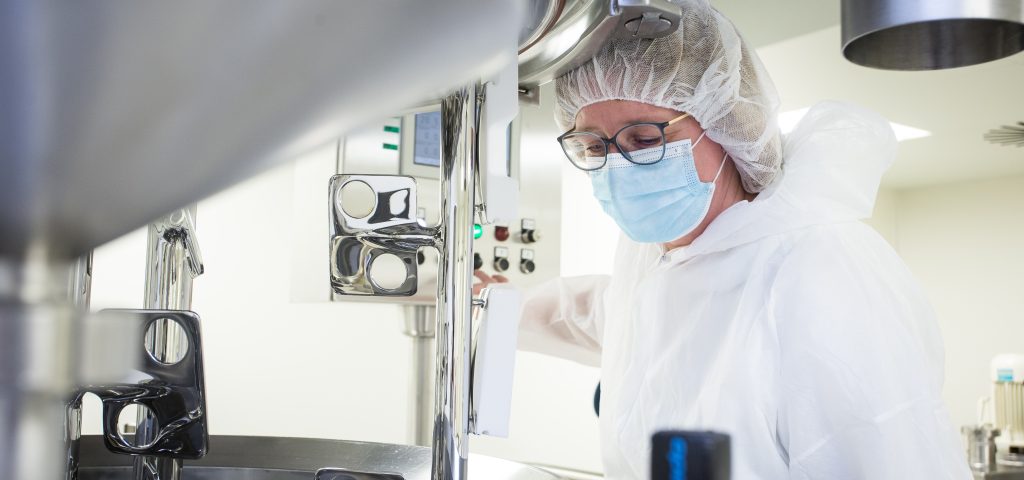
Semisolid manufacturing covers topical and transdermal dosage forms that sit between liquids and solids in consistency. These products include creams, ointments, gels and pastes, and they must be manufactured with tight control over uniformity, stability, spreadability and product performance.
At Adragos Leipzig, semisolid manufacturing is a core capability supported by technology transfer, scale-up, commercial manufacturing and tube packaging. The site supports creams, gels, ointments and healing pastes, combining operational expertise with GMP-aligned quality systems to help pharmaceutical partners move efficiently from transfer to routine supply.
What semisolid manufacturing involves
Semisolid dosage forms are used when local delivery, skin compatibility and patient usability matter. Depending on the formulation and intended application, a semisolid product may require fast spreadability, occlusive protection, controlled residence time or a defined release profile.
For that reason, semisolid manufacturing depends on more than batch production alone. It requires robust process control across mixing, heating and cooling, homogenisation, deaeration, in-process testing and packaging. Consistency in viscosity, pH, microstructure and fill performance is essential to maintaining product quality throughout scale-up and commercial manufacture.
Why semisolid dosage forms matter
Semi solid dosage forms play an important role across a wide range of pharmaceutical and dermocosmetic applications. They are often used where localised delivery, ease of application and patient acceptability are priorities.
Creams, ointments, gels and healing pastes can support different therapeutic and product requirements depending on their composition and intended use. Some formulations are designed for rapid absorption and spreadability, while others prioritise barrier protection, prolonged contact time or specific rheological properties. That makes manufacturing control particularly important, especially when products move from development into commercial supply.
End-to-end semisolid manufacturing in Leipzig
Adragos Leipzig supports the product lifecycle from technology transfer through to commercial manufacturing and packaging. The site is equipped for semisolid production across a range of batch sizes and packaging formats, helping partners align manufacturing processes with product requirements and market needs.
Semisolid contract manufacturing usually depends on more than formulation knowledge. It also depends on whether a site can transfer a process reliably, scale it appropriately, maintain product consistency and package it in a format that protects product integrity. At Leipzig, semisolid manufacturing is supported by production expertise, packaging capability and a quality-focused operating model designed for ongoing commercial supply.
What pharmaceutical partners can expect
When evaluating a semisolid manufacturing partner, operational reliability matters. Adragos Leipzig supports structured technology transfer, scale-up, routine commercial supply and pharmaceutical tube packaging for semisolid products. Process control is built around the factors that influence product consistency, including heating and cooling profiles, homogenisation, deaeration and in-process controls.
Quality and compliance are equally important. Semisolid manufacturing must be supported by a robust quality system, appropriate analytical controls and clear documentation throughout the product lifecycle. That includes testing of raw materials, bulk product and finished product, along with stability support, method development and validation where required.
For pharmaceutical companies outsourcing topical pharmaceutical manufacturing, the value of an experienced site lies in its ability to combine technical understanding with operational execution. That is particularly important for products where rheology, fill behaviour and packaging compatibility can influence both manufacturing performance and finished product quality.
Our semisolid portfolio
Adragos Leipzig’s semisolid portfolio is centred on four established product types.
Creams
Creams are semi-solid emulsions designed for topical or transdermal application. They are widely used where spreadability, skin feel and balanced oil-water composition are important. In manufacturing terms, creams require careful control of emulsion quality, viscosity and batch uniformity.
Ointments
Ointments are often selected where a more occlusive base or prolonged contact with the application site is required. Their manufacturing profile places particular emphasis on consistency, homogeneity and packaging compatibility, especially where higher viscosity systems are involved.
Gels
Gels can be suitable where lighter feel, rapid application or specific rheological performance is needed. Their production requires tight control of texture, stability and air management to maintain product quality during scale-up and filling.
Healing pastes
Healing pastes remain an important specialist category within semi solid dosage forms, particularly where barrier performance or higher solid content is needed. Their manufacture must account for product texture, uniform distribution and packaging suitability.
FAQs about semisolid manufacturing
What is semisolid manufacturing?
Semisolid manufacturing is the development, scale-up, manufacture and packaging of dosage forms such as creams, ointments, gels and pastes. It requires control of formulation behaviour, batch homogeneity, process parameters and packaging compatibility.
What are examples of semi solid dosage forms?
Common examples include creams, ointments, gels and healing pastes.
Why is process control important in semisolid manufacturing?
Process control helps maintain consistency in viscosity, pH, microstructure, uniformity and stability. For topical products, those parameters can affect product performance, handling and quality throughout scale-up and commercial supply.
What packaging formats are used for semisolids at Adragos Leipzig?
Semisolid products can be filled into aluminium and plastic tubes, depending on the product profile, pack format and market requirements.
What support is available beyond manufacturing?
A strong semisolid manufacturing partner should support technology transfer, scale-up, commercial production, packaging, analytical work, stability activities and regulatory requirements as part of a broader product lifecycle approach.
