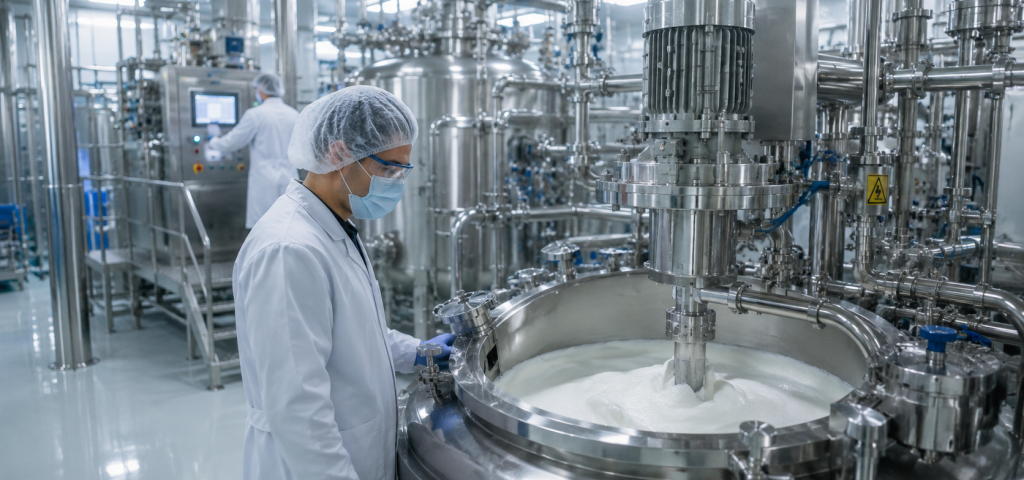
Pharmaceutical semisolid and liquid manufacturing scale-up is not a larger version of the laboratory batch. It is the disciplined translation of formulation science, process understanding, equipment capability and GMP control into a repeatable commercial process.
For development and manufacturing leaders, the central question is practical: how do pharmaceutical companies scale up semisolid and liquid manufacturing from development to commercial production without losing control of product quality?
The answer is a stage-gated, risk-based scale-up strategy. Companies define critical quality attributes, understand scale-sensitive process parameters, select equipment that can reproduce the intended shear and mixing environment, complete technology transfer with documented process knowledge, and validate the commercial process under GMP.
This approach aligns with the lifecycle expectations described in ICH Q8(R2), ICH Q9(R1), ICH Q10 and process validation guidance, where development knowledge, quality risk management, technology transfer and continued process verification are connected across the product lifecycle.
Step 1: Define the product quality target before scaling the batch
Effective scale-up starts with the product, not the vessel size.
For semisolid dosage forms such as creams, gels, ointments and lotions, typical critical quality attributes include assay, content uniformity, viscosity, rheology, pH, appearance, globule or particle size, phase stability, microbial limits, preservative effectiveness, spreadability and fill performance.
For liquid dosage forms such as solutions, suspensions and oral liquids, the control focus may include assay, pH, clarity or suspension uniformity, dissolution state, particle size distribution, preservative content, bioburden, fill volume, extractables and leachables risk, and stability.
The first scale-up decision is therefore not “how large is the batch?” It is “which attributes must remain equivalent as we move from development to commercial production?”
Step 2: Map CQAs to CMAs and CPPs
Once the quality target is clear, companies link critical quality attributes to critical material attributes and critical process parameters.
For semisolids, scale-sensitive parameters often include:
- Order of addition
- Hydration time for polymers
- Heating and cooling profiles
- Emulsification temperature
- Homogenisation speed, pressure or time
- Sweep agitation and wall-scrape efficiency
- Vacuum level and deaeration time
- Bulk hold time before filling
For liquids, the equivalent parameters may include:
- Agitation speed and impeller type
- Dissolution time
- Powder addition rate
- Temperature control
- Recirculation flow rate
- Filtration parameters
- Settling control for suspensions
- Transfer line configuration and hold conditions
This is where manufacturing process optimisation begins. The development team must identify which parameters genuinely affect the product and which are operational preferences. A parameter that controls droplet size, viscosity build, suspension uniformity or microbial risk belongs in the control strategy.
Step 3: Build a formulation that can survive commercial reality
A formulation may look robust in a glass beaker and still fail in a 1,000 litre vessel.
At larger scale, heat transfer slows down, mixing zones become less uniform, shear exposure changes, deaeration becomes harder and transfer losses become more visible. Semisolid products may show viscosity drift, phase separation, poor texture, air entrapment or inconsistent filling. Liquid products may show incomplete dissolution, sedimentation, foaming, filtration slowdown or assay variability due to poor mixing.
This is why process development to commercial production must include manufacturability testing. The target is not only the right composition. It is the right composition supported by a scalable process.
Step 4: Use pilot scale as the technical bridge
Pilot batches are the bridge between formulation development and commercial manufacturing. They help confirm whether the process is directionally scalable before the company commits to commercial equipment and validation.
Pilot work should test mixing efficiency, homogenisation conditions, temperature ramps, cooling rates, transfer losses, filtration behaviour, bulk hold times, filling performance and cleaning feasibility. It should also generate data for stability, process characterisation and technology transfer.
For semisolid products, pilot batches are especially useful for understanding rheology, thixotropy, deaeration, emulsion droplet size and cooling-related structure formation. For liquids, they are valuable for confirming dissolution endpoints, suspension uniformity, filtration performance and fill volume control.
Step 5: Select equipment based on process function, not habit
Equipment selection for semisolid and liquid dosage forms should be based on the process function required to protect the critical quality attributes.
A semisolid manufacturing train may include jacketed vacuum processing vessels, sweep agitators, high-shear homogenisers, recirculation loops, transfer pumps, deaeration systems, holding vessels and tube or jar filling lines. Vacuum capability and wall scraping are often important where air entrapment, heat transfer and viscosity control are significant risks.
A liquid manufacturing train may include stainless steel mixing tanks, impellers matched to the fluid behaviour, inline mixers, recirculation loops, filtration skids, sanitary transfer lines, holding vessels and bottle filling systems. For microbial control, water quality, cleaning, sanitisation and closed transfer design must be considered early.
The FDA SUPAC-SS guidance for nonsterile semisolid dosage forms specifically addresses changes in components, composition, manufacturing process, equipment, scale-up or scale-down, and site of manufacture, which reinforces the need to treat scale and equipment decisions as CMC-relevant decisions rather than purely operational choices.
Step 6: Apply engineering scale-up principles carefully
Commercial scale-up is not achieved by multiplying every laboratory parameter by the batch size.
The team may evaluate geometric similarity, impeller design, tip speed, power per unit volume, Reynolds number, shear history, residence time, heat transfer coefficient and mixing time. The right criterion depends on the product.
For an emulsion cream, droplet size and shear history may drive performance. For a carbomer gel, hydration and neutralisation sequence may dominate. For a suspension, agitation must keep particles uniformly distributed without causing unacceptable particle attrition or foam formation.
The practical point is simple: choose the scale-up model that reflects the product risk.
Step 7: Execute technology transfer with operational discipline
A strong scale-up strategy and technology transfer package should include more than a formula and a batch record.
The receiving site needs the development history, formulation rationale, known sensitivities, equipment assumptions, acceptable parameter ranges, in-process controls, analytical methods, cleaning requirements, hold-time data, sampling plans, deviation history and unresolved risks.
The transfer should also include operator training, engineering runs where appropriate, QA review, analytical method transfer, raw material equivalency assessment and packaging line trials. Technology transfer fails when tacit knowledge stays with the sending team. It succeeds when critical process knowledge becomes controlled, reviewable and usable on the manufacturing floor.
Step 8: Establish the GMP control strategy
The commercial control strategy should define how the process will remain in control batch after batch.
Typical controls include raw material specifications, approved suppliers, dispensing checks, water quality, mixing and homogenisation setpoints, temperature ranges, pH, viscosity, appearance, density, microbial limits, bioburden monitoring, filter or screen controls, bulk hold times, line clearance, fill weight or fill volume checks, container closure controls and finished product release testing.
Data integrity is central. Batch records, equipment logs, laboratory records and electronic systems must follow ALCOA+ principles: attributable, legible, contemporaneous, original, accurate, complete, consistent, enduring and available.
Step 9: Validate the commercial process
GMP compliance and validation convert process understanding into documented evidence.
Commercial readiness typically includes equipment qualification, utility qualification, cleaning validation, analytical method validation or transfer, computerised system validation where relevant, process performance qualification and ongoing continued process verification. FDA process validation guidance describes process validation as lifecycle work that extends from process design through commercial production and continued verification.
For semisolids and liquids, validation protocols should pay particular attention to mixing uniformity, worst-case viscosity, hold times, microbial control, cleaning difficulty, transfer losses, filtration or screening performance, and filling consistency.
Reality check: scale-up issues will happen
Even well-designed scale-up programmes encounter atypical results, deviations, OOS or OOT results, equipment constraints and unexpected product behaviour.
The differentiator is the quality of the response. Teams need rapid containment, documented risk assessment, phase 1 and phase 2 investigation where appropriate, hypothesis-driven troubleshooting, scientifically justified root cause analysis, CAPA, effectiveness checks and trend review.
Investigations are detective work: evidence, hypotheses and disciplined conclusions. Weak investigations create repeat deviations. Strong investigations convert scale-up friction into process knowledge.
Practical takeaways for manufacturing leaders
Use this checklist before moving from development to commercial production:
- Define CQAs for the dosage form before selecting commercial equipment.
- Identify scale-sensitive CPPs such as shear, mixing time, temperature profile, deaeration and hold time.
- Use pilot batches to challenge the process, not merely to confirm assumptions.
- Select equipment based on the product’s rheology, mixing needs, microbial risk and filling behaviour.
- Document technology transfer knowledge in a way operators, QA and MSAT can use.
- Build in-process controls around the parameters that protect quality.
- Validate cleaning, hold times, analytical methods and commercial process performance.
- Maintain continued process verification after launch.
- Manage improvements through change control and lifecycle risk management.
Conclusion
Scaling semisolid and liquid dosage forms from development to commercial production is a technical translation exercise. The product must remain the same, but the process environment changes dramatically.
The companies that scale successfully do not rely on batch size alone. They connect formulation science, equipment selection, process engineering, GMP validation and quality culture. That is how pharmaceutical semisolid and liquid manufacturing scale-up becomes more than a transfer activity. It becomes a controlled pathway from development promise to reliable patient supply.
For CDMOs and sponsors preparing a semisolid or liquid product for commercialisation, the strongest starting point is a disciplined scale-up strategy and technology transfer plan that treats product quality, manufacturability and GMP compliance as one integrated system.
