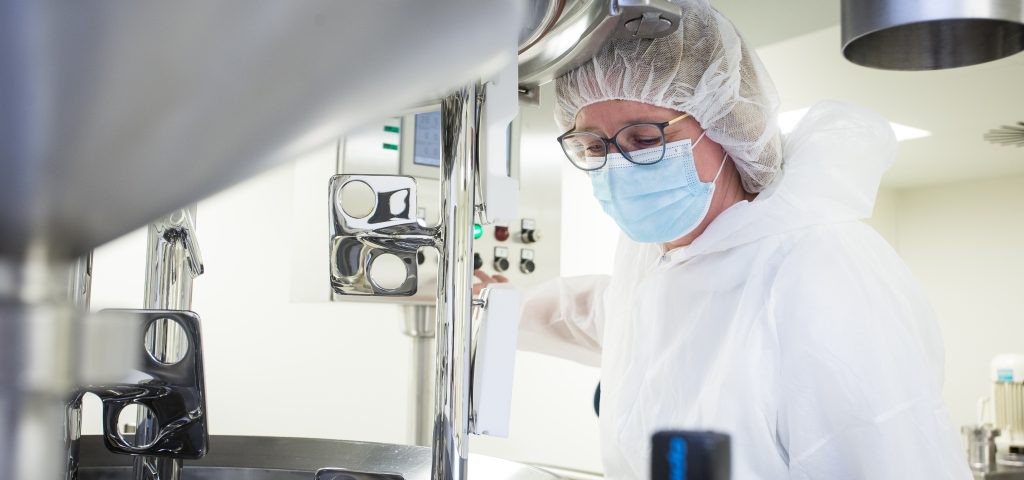
Scaling semi-solid and liquid pharmaceutical products from development batches to commercial volumes requires a disciplined sequence of technology transfer, equipment qualification and process validation activities. For creams, ointments, gels, suspensions, solutions and syrups, the rheological behaviour, homogeneity and microbiological control that are straightforward at laboratory scale become significantly more complex once batch sizes increase. This guide outlines the structured approach used by experienced Contract Development and Manufacturing Organisations to move products through pharmaceutical manufacturing scale-up without compromising quality, regulatory compliance or supply continuity.
What Does Scaling Semi-solid and Liquid Drug Production Involve?
Pharmaceutical manufacturing scale-up is the process of transferring a formulation from development or pilot scale to a qualified commercial production environment, then validating that the process consistently delivers product meeting predefined specifications. For semi-solids and liquids, this typically involves four sequential phases: process development, technology transfer, engineering and validation batches, and routine commercial manufacturing. Each phase has defined deliverables and acceptance criteria that must be met before the next phase begins.
Phase 1: Pharmaceutical Process Development
Before scale-up can begin, the formulation and the manufacturing process must be sufficiently characterised. At this stage, development teams define the critical quality attributes of the product and identify the critical process parameters that influence them. For semi-solids, these often include mixing speed, shear rate, temperature ramp profiles, homogenisation duration and cooling rates. For liquid products, parameters such as order of addition, dissolution time, filtration strategy and bioburden control typically dominate.
Robust process development should produce:
- A documented manufacturing process description.
- Defined critical quality attributes and critical process parameters.
- Analytical methods suitable for routine release testing.
- Stability data supporting the proposed shelf life.
- A risk assessment identifying potential scale-up challenges.
Without this foundation, downstream technology transfer activities carry significant risk of failure.
Phase 2: Technology Transfer
Technology transfer is the structured movement of product, process and analytical knowledge from a sending site, often the originator’s laboratory or a pilot facility, to the receiving commercial manufacturing site. A well-executed transfer reduces the likelihood of deviations during validation and accelerates time to first commercial batch.
Key Technology Transfer Deliverables
- Transfer protocol and project plan defining scope, responsibilities, timelines and success criteria.
- Gap analysis comparing the sending site’s equipment, utilities and analytical capabilities with those of the receiving site.
- Raw material and packaging component qualification to confirm that suppliers, grades and specifications are aligned.
- Analytical method transfer including method verification or co-validation to demonstrate equivalent performance at the receiving site.
- Process fit assessment to confirm that vessel geometry, mixer design, heat transfer capacity and filling equipment are appropriate for the formulation.
For semi-solid and liquid products, equipment differences between scales are particularly important. Mixing dynamics, heat transfer surface area to volume ratios and shear profiles do not scale linearly, and these differences must be modelled or empirically tested before engineering batches commence.
Phase 3: Engineering and Validation Batches
Once the transfer is complete, manufacturing trials begin at commercial scale.
Engineering Batches
Engineering batches are non-Good Manufacturing Practice or partially compliant runs used to refine the process at full scale. They allow operators to confirm equipment settings, sequence timing, in-process control sampling points and cleaning procedures before committing to validation. For semi-solids, engineering batches frequently reveal differences in cooling profiles or air entrainment that require process adjustment.
Process Performance Qualification
Process Performance Qualification, the second stage of process validation as defined by the European Medicines Agency and the United States Food and Drug Administration, demonstrates that the commercial process operates reproducibly. Typically, three consecutive successful batches manufactured under routine conditions are required, with comprehensive sampling and testing against predefined acceptance criteria.
For liquid production scaling, validation should specifically address:
- Content uniformity across the batch and throughout the filling run.
- Microbiological control, including hold times and bioburden limits before sterilising filtration where applicable.
- Container closure integrity.
- Stability of validation batches under International Council for Harmonisation conditions.
For semi-solid manufacturing, additional attention is given to:
- Homogeneity of Active Pharmaceutical Ingredient distribution within the matrix.
- Viscosity and rheological consistency across the batch.
- Tube or jar fill weight uniformity.
- Visual appearance and absence of phase separation.
Phase 4: Commercial Drug Production
Following successful Process Performance Qualification, the product enters routine commercial manufacturing under the continued process verification framework. This third stage of validation requires ongoing monitoring of process performance to detect drift, support continuous improvement and maintain a state of control. Trending of critical process parameters and critical quality attributes is documented in periodic product quality reviews.
Lifecycle management also includes change control for any modification to equipment, suppliers, batch size or process parameters, with each change assessed for revalidation requirements.
Common Scale-Up Challenges for Semi-solids and Liquids
Even with rigorous planning, certain scale-up challenges recur across semi-solid and liquid programmes:
- Mixing and shear differences between pilot and commercial vessels affecting emulsion stability or particle size distribution.
- Heat transfer limitations in larger jacketed vessels producing different cooling profiles, which can alter crystallisation or viscosity.
- Air incorporation during high-shear mixing leading to product defects in semi-solids.
- Hold time impacts on bioburden, viscosity or chemical stability of bulk product before filling.
- Filling line compatibility with viscous or shear-sensitive formulations.
- Cleaning validation complexity for products with low solubility or strong colour.
Anticipating these issues during process development and addressing them in the transfer protocol significantly reduces validation risk.
How Adragos Pharma Supports Semi-solid and Liquid Scale-Up
Adragos Pharma operates dedicated facilities for the development and commercial manufacture of liquid and semi-solid pharmaceutical products, including its site in Leipzig, Germany, which specialises in these dosage forms. The company supports clients across the full scale-up pathway, from formulation development and analytical method transfer through engineering batches, Process Performance Qualification and routine commercial supply. Integrated quality, regulatory and supply chain teams manage technology transfer projects under defined governance structures, with the objective of delivering predictable timelines and validated commercial processes.
Key Takeaways for Development Leaders
- Pharmaceutical manufacturing scale-up should follow four structured phases: development, technology transfer, engineering and validation, and commercial production.
- Critical quality attributes and critical process parameters must be defined before transfer begins.
- Equipment differences in mixing, shear and heat transfer are the most common sources of scale-up challenges for semi-solids and liquids.
- Process Performance Qualification typically requires three consecutive successful batches under routine conditions.
- Continued process verification maintains the validated state throughout the commercial lifecycle.
- Selecting a Contract Development and Manufacturing Organisation with proven experience in semi-solid and liquid dosage forms, qualified equipment trains and an established technology transfer methodology is one of the most effective ways to reduce timeline risk in commercial drug production.
Frequently Asked Questions
What are the phases of scaling semi-solid and liquid drug production?
Scaling semi-solid and liquid drug production follows four sequential phases: pharmaceutical process development, technology transfer, engineering and validation batches, and routine commercial production. Each phase has defined deliverables and acceptance criteria that must be met before the next phase begins.
How many batches are required for Process Performance Qualification?
Process Performance Qualification typically requires three consecutive successful batches manufactured under routine commercial conditions, with comprehensive sampling and testing against predefined acceptance criteria.
What are the most common scale-up challenges for semi-solids and liquids?
The most common challenges are equipment-related: differences in mixing and shear between pilot and commercial vessels, heat transfer limitations in larger jacketed vessels, air incorporation during high-shear mixing, hold time impacts on bulk product, filling line compatibility with viscous formulations, and cleaning validation complexity. These differences do not scale linearly and should be modelled or tested before engineering batches.
Why is technology transfer important in pharmaceutical scale-up?
Technology transfer is the structured movement of product, process and analytical knowledge from the sending site to the receiving commercial site. A well-executed transfer reduces the likelihood of deviations during validation and accelerates time to first commercial batch.
