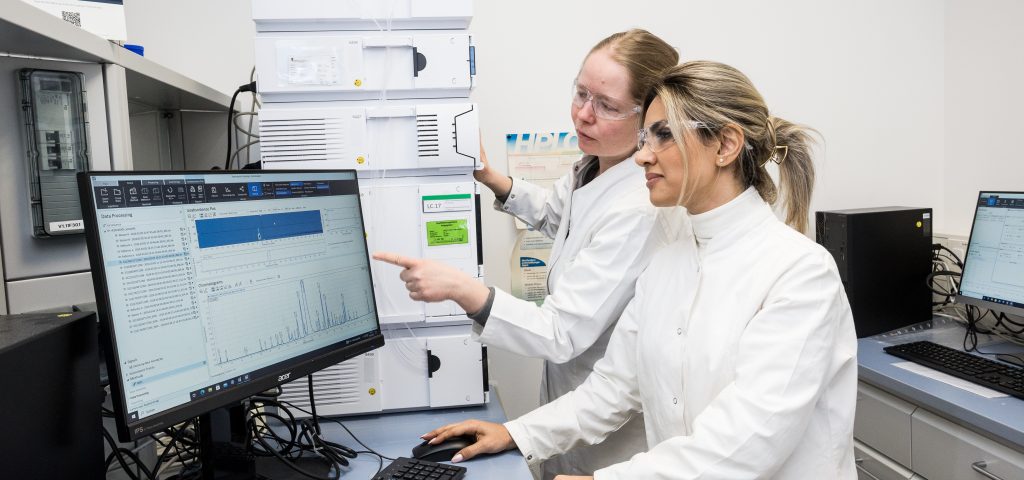
Pharmaceutical scale-up for semi-solid and liquid products is the structured transfer of a formulation from laboratory or pilot scale to commercial manufacturing batches. The process requires alignment between formulation behaviour, equipment geometry, process parameters and quality controls, so that the product retains its critical quality attributes at every batch size. For developers, the scale-up phase often determines whether a candidate reaches market on its planned timeline.
This article explains how semi-solid and liquid scale-up is managed in a Contract Development and Manufacturing Organisation environment, what risks typically appear and how those risks are mitigated through technical transfer, equipment fit and regulatory readiness.
What Is Pharmaceutical Manufacturing Scale-Up?
Pharmaceutical manufacturing scale-up is the engineering and quality exercise of reproducing a developed formulation at progressively larger batch sizes while maintaining identical product performance. For semi-solids such as creams, ointments and gels, and for liquids such as solutions, suspensions and syrups, the central challenge is that mixing, heat transfer and shear forces do not scale linearly with vessel volume.
A successful scale-up programme produces a process that is:
- Reproducible across multiple commercial batches.
- Aligned with the validated control strategy.
- Supported by documented equipment qualification.
- Compliant with Good Manufacturing Practice expectations of the target market.
Why Semi-Solids and Liquids Require Distinct Scale-Up Approaches
Semi-solids and liquids behave differently under industrial conditions than they do in development laboratories. Viscosity, droplet size, phase stability and homogeneity are sensitive to vessel geometry, impeller design, temperature ramp rates and vacuum profiles.
For semi-solid manufacturing, the rheology of the product can shift markedly when emulsification is performed in a 1,000 litre vessel rather than a 5 litre laboratory mixer. For liquid production scaling, factors such as dissolution kinetics, aeration and sterilisation profiles must be reassessed at each step.
These dynamics mean that scale-up is rarely a simple multiplication of volumes. It is a deliberate engineering exercise built on data from pilot batches.
The Core Phases of Semi-Solid and Liquid Scale-Up
1. Technical Transfer and Process Characterisation
The first phase is the structured transfer of formulation knowledge from the originating site or laboratory to the commercial manufacturing site. This typically includes:
- A gap analysis between development and commercial equipment.
- Identification of critical process parameters and critical quality attributes.
- Mapping of in-process controls to the analytical method portfolio.
- Risk assessment using a structured tool such as Failure Mode and Effects Analysis.
At Adragos Pharma, technical transfer is treated as a defined project phase with cross-functional ownership across formulation development, manufacturing, quality assurance and regulatory affairs.
2. Equipment Fit and Engineering Assessment
Equipment fit is the determination of whether the receiving site’s vessels, homogenisers, filling lines and utilities can reproduce the developed process. For semi-solids this includes assessing:
- Vessel geometry and impeller configuration.
- Homogenisation tip speed and residence time.
- Heating and cooling jacket performance.
- Vacuum capability for de-aeration.
For liquids, the assessment focuses on mixing efficiency, filtration trains, filling accuracy and, where relevant, sterilisation cycles. When equipment is not a direct match, process parameters must be adapted and justified with supporting data.
3. Pilot and Engineering Batches
Pilot and engineering batches bridge the development scale and the commercial scale. They confirm that adjusted parameters deliver a product within specification and generate the data required for process validation. The output of this phase typically informs:
- Final master batch records.
- In-process control limits.
- Cleaning validation strategy.
- Stability programme design.
4. Process Validation and Commercial Drug Production
Process validation demonstrates, through three or more consecutive successful commercial batches, that the manufacturing process consistently produces material meeting predefined quality criteria. Once validation is complete, the product enters routine commercial drug production under continuous process verification, with deviations and trends monitored through the quality management system.
Common Scale-Up Challenges and How They Are Managed
| Challenge | Typical Cause | Mitigation |
|---|---|---|
| Viscosity drift in semi-solids | Differences in shear input between scales | Adjust homogenisation speed and duration based on pilot data |
| Phase separation in emulsions | Inadequate cooling profile at larger scale | Redesign jacket cooling and add controlled holding steps |
| Content uniformity in suspensions | Settling during transfer or filling | Optimise in-line agitation and filling line residence time |
| Microbial control in aqueous liquids | Extended hold times in large vessels | Define maximum hold periods supported by microbial challenge data |
| Regulatory variation risk | Changes that exceed post-approval flexibility | Plan change strategy aligned to the relevant regulatory framework |
These scale-up challenges are best addressed early in pharmaceutical process development, when formulation choices can still accommodate manufacturability considerations.
Quality Controls Across the Scale-Up Lifecycle
Quality oversight is continuous throughout scale-up. Typical control elements include analytical method transfer, in-process testing at defined hold points, finished product release testing and ongoing stability monitoring. The control strategy is documented and aligned with International Council for Harmonisation guidelines, including the principles of Quality by Design where applicable.
For semi-solid and liquid products, particular attention is given to:
- Homogeneity and content uniformity.
- Viscosity and rheological profile.
- pH and osmolality where relevant.
- Microbial quality and preservative efficacy.
- Container closure integrity.
Regulatory Considerations for Scale-Up
Regulatory risk during scale-up is managed by ensuring that any changes between the developed process and the commercial process are documented, justified and, where required, reported to health authorities. The level of regulatory action depends on the product’s lifecycle stage and the markets involved. For products already approved, scale-up changes are typically managed through variation procedures aligned to the European Medicines Agency, the United States Food and Drug Administration or other applicable frameworks.
Working with a Contract Development and Manufacturing Organisation that has established regulatory infrastructure reduces the risk of unexpected filing requirements or inspection findings.
How Adragos Pharma Supports Semi-Solid and Liquid Scale-Up
Adragos Pharma provides integrated development, technical transfer and commercial manufacturing services for semi-solid and liquid pharmaceutical products. Its manufacturing network supports a range of batch sizes, with quality systems aligned to international Good Manufacturing Practice standards. Clients are supported through structured project management, formulation expertise and validated analytical capability across the scale-up lifecycle.
For pharma and biotech developers preparing for commercial launch, early engagement on equipment fit, process characterisation and regulatory strategy typically shortens the path from pilot to validated commercial supply.
Frequently Asked Questions
What is the main difference between semi-solid and liquid scale-up?
Semi-solid scale-up is dominated by rheology, shear and emulsion stability, whereas liquid scale-up focuses on mixing efficiency, dissolution, filtration and, for sterile products, sterilisation cycles. Both require equipment-specific characterisation rather than direct volumetric scaling.
When should scale-up planning begin?
Scale-up planning should begin during pharmaceutical process development, ideally before the formulation is locked. Early consideration of manufacturability reduces the likelihood of rework during pilot and validation phases.
How many batches are required for process validation?
Most regulatory frameworks expect a minimum of three consecutive successful commercial-scale batches, supported by a justified validation protocol and ongoing process verification.
Can scale-up be performed without changing the registered process?
Minor scale-up activities can often be accommodated within the existing registration, but significant changes to equipment, batch size or process parameters typically require a regulatory variation. The classification depends on the relevant authority and product type.
