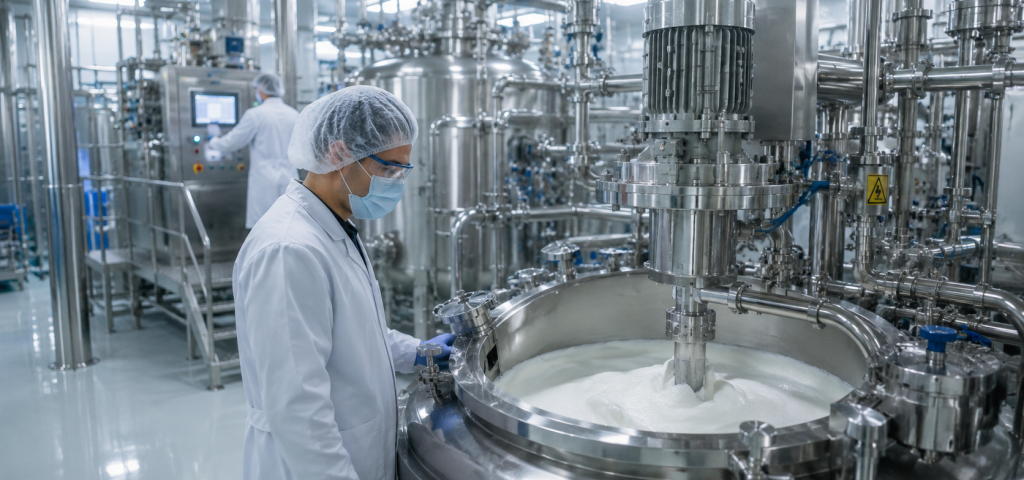
Scaling semisolid and liquid pharmaceutical products from laboratory to commercial manufacturing requires a systematic progression through formulation development, pilot batch production, process validation and technology transfer. Each stage introduces new critical process parameters that must be understood and controlled before advancing to the next. Adragos Leipzig, a European Union Good Manufacturing Practice-certified contract manufacturing facility with over 100 years of production experience, supports drug developers across this entire journey, from early formulation work through to high-volume commercial supply.
Table of Contents
- What scaling a semisolid or liquid product actually involves
- Stage one: formulation development and recipe optimisation
- Stage two: pilot batch production
- Stage three: process validation
- Stage four: technology transfer to commercial manufacturing
- Critical process parameters for semisolids and liquids
- Equipment selection and its role in scalable manufacturing
- Analytical testing and quality control throughout scale-up
- Stability studies at scale
- How Adragos Leipzig supports scale-up from 15 litres to 4,000 litres
- Frequently asked questions
What Scaling a Semisolid or Liquid Product Actually Involves
Pharmaceutical manufacturing scale-up is not simply a matter of increasing batch size. As a product moves from a laboratory bench to a commercial production line, the physical and chemical conditions governing mixing, heat transfer and shear forces change considerably. These changes can affect the homogeneity of a cream, the droplet size distribution of an emulsion, the dissolution rate of a suspension or the viscosity profile of a gel.
For semisolid products including creams, gels, ointments and healing pastes, the critical challenges at scale are thermal management during heating and cooling phases, homogenisation efficiency and deaeration. For non-sterile liquid products including solutions, drops, suspensions and emulsions, the key considerations are mixing uniformity, particle size consistency, dissolution kinetics and pH stability at larger volumes.
Understanding these distinctions from the outset determines how successfully a product transitions through each manufacturing stage.
Stage One: Formulation Development and Recipe Optimisation
The first step in any scale-up programme is establishing a robust formulation at laboratory scale. This involves identifying the active pharmaceutical ingredient concentration, excipient system, pH target, physical form and processing conditions that together produce the desired product quality attributes.
At this stage, the formulation team develops tailor-made formulations by evaluating different excipient combinations and manufacturing approaches. The objective is to identify a recipe that is not inherently sensitive to small changes in process conditions, a principle aligned with design space definition under International Council for Harmonisation Q8 guidelines.
Adragos Leipzig conducts this work as part of its galenical development service, which encompasses recipe development, manufacturing process optimisation and the preparation of the first pilot batch at laboratory scale.
Stage Two: Pilot Batch Production
Once a formulation has been established at laboratory scale, the next step is to produce pilot batches at an intermediate volume. Pilot batches serve two purposes. First, they allow the manufacturing team to confirm that the formulation behaves consistently at larger volumes. Second, they generate product and process data that informs the process validation strategy.
At Adragos Leipzig, semisolid development begins at batch sizes from 15 litres, progressing in a controlled manner towards commercial-scale production volumes. During pilot batch manufacture, the team documents critical process parameters including:
- Mixing speed and duration
- Heating and cooling temperature profiles
- Homogenisation intensity and time
- Deaeration conditions
- In-process control results
These parameters form the basis of the batch record that will be used for process validation and, subsequently, for routine commercial production.
Stage Three: Process Validation
Process validation is the documented evidence that a manufacturing process consistently produces a product meeting its predetermined specifications and quality attributes. Regulatory authorities including the European Medicines Agency and the United States Food and Drug Administration require process validation before a product can enter commercial sale.
For semisolid and liquid products, process validation typically involves the manufacture of a defined number of consecutive batches at commercial scale under the conditions described in the product’s regulatory submission. The validation protocol specifies acceptance criteria for critical quality attributes such as viscosity, pH, content uniformity, microbial limits and physical appearance.
Adragos Leipzig provides validation of manufacture as a defined service, alongside the creation of product quality reviews, ensuring the validation programme meets both European Union and international regulatory requirements.
Stage Four: Technology Transfer to Commercial Manufacturing
Technology transfer is the formal process by which the formulation, manufacturing process and analytical methods developed at one scale or one site are transferred to the commercial manufacturing environment. A well-executed technology transfer ensures that nothing critical is lost in the transition and that the commercial site can reproduce the process with full understanding of its parameters and constraints.
At Adragos Leipzig, technology transfer and galenical development are managed as an integrated service. This includes transfer management, analytical method transfer with full documentation and batch release procedures carried out by a Qualified Person. Serialisation in compliance with the European Union Falsified Medicines Directive is included as part of the commercial manufacturing service.
Critical Process Parameters for Semisolids and Liquids
Understanding which process parameters are critical, and how they behave at different scales, is central to a successful scale-up programme. The table below summarises the key parameters by dosage form.
| Dosage Form | Critical Process Parameters |
|---|---|
| Creams and emulsions | Temperature during emulsification, mixing speed, homogeniser intensity, cooling rate |
| Gels | Polymer hydration time and temperature, mixing uniformity, pH adjustment |
| Ointments | Temperature of active pharmaceutical ingredient incorporation, mixing time, batch homogeneity |
| Solutions | Dissolution time, mixing speed, pH stability, hold time |
| Suspensions | Particle size distribution, mixing uniformity, settling behaviour |
| Emulsions | Droplet size distribution, emulsification energy input, temperature profile |
At larger scales, heat transfer and mixing efficiency differ substantially from laboratory conditions. A homogeniser that produces a specific shear profile at 50 litres will not replicate that profile identically at 1,000 litres. Understanding this scaling factor and compensating for it through equipment selection and process parameter adjustment is the core technical challenge of pharmaceutical manufacturing scale-up.
Equipment Selection and Its Role in Scalable Manufacturing
Equipment selection has a direct bearing on whether a product scales successfully. The choice of mixing vessel geometry, homogeniser type, pump configuration and heat exchanger capacity all influence product quality at commercial scale.
Adragos Leipzig operates two semisolid production lines equipped with Marchesini and Norden machinery, supported by an EKATO mixing tank. For non-sterile liquid products, three dedicated production lines utilise Dovema, Würschum and Groninger equipment, with batch capacities reaching up to 4,000 litres.
Commercial container formats available at Leipzig include:
- Semisolids: laminate and plastic tubes (25 g to 200 g) and aluminium tubes (2 g to 150 g)
- Non-sterile liquids: plastic and glass bottles from 20 mL to 700 mL
Having access to commercial-scale equipment during development and pilot batch phases means that process parameters established at smaller scales can be translated into commercial manufacturing conditions with greater confidence.
Analytical Testing and Quality Control Throughout Scale-Up
Robust analytical testing is required at every stage of the scale-up process, from raw material release through in-process control to finished product batch release. Analytical methods must be fit for purpose at each scale and must be formally transferred when production moves to a new scale of operation.
Adragos Leipzig’s quality control laboratory supports routine analytics including:
- Raw material analysis of active pharmaceutical ingredients and excipients
- Bulk and finished product analysis
- Batch release testing for solid, liquid and semisolid formulations
- Residual solvent investigation
- Microbiology testing including Total Aerobic Microbial Count and Total Yeast and Mould Count determination
Techniques available include High-Performance Liquid Chromatography, Gas Chromatography, Gas Chromatography headspace analysis, ultraviolet-visible spectroscopy and titration. Method development, validation and formal transfer are included within the analytical service offering.
Stability Studies at Scale
Stability testing confirms that a product remains within its specification throughout its proposed shelf life under the storage conditions relevant to its target markets. As batch size increases through scale-up, stability data generated at smaller scales must be supplemented with data from commercial-scale or pilot-scale batches.
Adragos Leipzig operates stability chambers covering International Council for Harmonisation climate zones II, IVa and IVb, with alarm-controlled monitoring of temperature and humidity and a computer-aided scheduling and data management system. Stability studies are offered during both clinical development and post-approval stages.
How Adragos Leipzig Supports Scale-Up From 15 Litres to 4,000 Litres
Adragos Leipzig provides a fully integrated contract development and manufacturing service for semisolid and non-sterile liquid products. With a production area of 13,300 square metres and over 100 years of manufacturing heritage, the facility brings together galenical development expertise, pilot batch capability, commercial-scale production and analytical support under a single European Union Good Manufacturing Practice-certified operation.
The full service scope at Leipzig includes:
- Galenical formulation development and recipe optimisation
- Pilot batch production and process development
- Technology transfer management
- Analytical method development, validation and transfer
- Process validation and product quality reviews
- Stability studies across International Council for Harmonisation climate zones
- Commercial manufacture with Qualified Person batch certification
- Serialisation in compliance with the European Union Falsified Medicines Directive
- Secondary packaging and controlled drug handling
The facility holds European Union Good Manufacturing Practice certification for both human and animal pharmaceutical products, accommodating a broad range of product types from specialised pharmaceutical formulations through to cosmetic-adjacent topical preparations. Leipzig operates as part of the wider Adragos Pharma global network, which spans seven Good Manufacturing Practice-certified facilities across Europe and Japan.
To discuss your semisolid or liquid scale-up programme with the Adragos Leipzig team, contact us here.
Frequently Asked Questions
What is the difference between scaling a semisolid and a liquid pharmaceutical product?
The core challenge for semisolids lies in controlling homogenisation, temperature and shear at increasing batch sizes. For non-sterile liquids, the primary concerns are mixing uniformity, dissolution rate and, for suspensions, particle size distribution. Both require careful evaluation of critical process parameters at each transition point in the scale-up journey.
What batch sizes are available for semisolid scale-up at Adragos Leipzig?
Semisolid batch sizes at Adragos Leipzig range from 15 litres up to 1,250 litres across two production lines equipped with Marchesini and Norden machinery. Non-sterile liquid batches can be produced at volumes up to 4,000 litres across three production lines.
What stability zones are supported at Adragos Leipzig?
Adragos Leipzig supports stability testing under International Council for Harmonisation climate zone II, IVa and IVb conditions. Chambers are fitted with alarm-controlled monitoring of temperature and humidity and are managed through a computer-aided scheduling and data management system. Stability studies are available during clinical development and post-approval stages.
What analytical methods are used during scale-up at Adragos Leipzig?
Available analytical methods include High-Performance Liquid Chromatography, Gas Chromatography, Gas Chromatography headspace analysis, ultraviolet-visible spectroscopy and titration. Microbiological testing, including Total Aerobic Microbial Count and Total Yeast and Mould Count determination, is also available. Method development, validation and formal transfer are included within the analytical service offering.
Does Adragos Leipzig offer batch certification by a Qualified Person?
Yes. Batch certification by a Qualified Person is included as part of the commercial manufacturing service at Adragos Leipzig, alongside serialisation in compliance with the European Union Falsified Medicines Directive.
Does Adragos Leipzig handle controlled drugs?
Yes. Adragos Leipzig has controlled drug handling capability, supporting a range of product types from standard pharmaceutical formulations through to products requiring additional regulatory controls.
What is the GMP certification status of Adragos Leipzig?
Adragos Leipzig holds European Union Good Manufacturing Practice certification for both human and animal pharmaceutical products. The facility was founded in 1926 and operates across a 13,300 square metre production area in eastern Germany.
