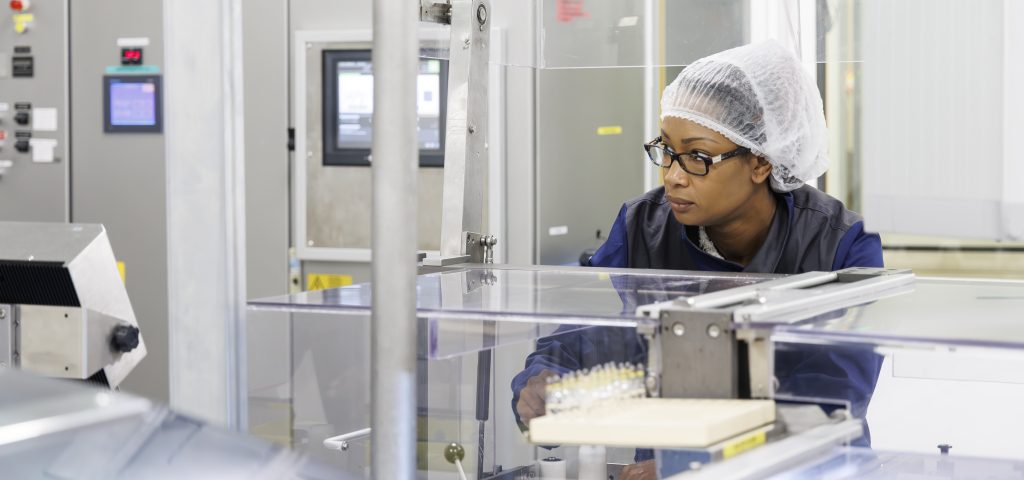
Scaling a sterile injectable from clinical batches to validated commercial supply is one of the most demanding transitions in pharmaceutical manufacturing. It requires synchronised progress across Contract Development and Manufacturing Organisation (CDMO) selection, technology transfer, Chemistry, Manufacturing and Controls (CMC) readiness, capacity planning and supply risk control. This guide sets out a structured approach for pharmaceutical and biotechnology development and manufacturing leaders preparing for commercial launch.
What Does It Take to Scale Sterile Injectables to Commercial Supply?
Scaling sterile injectables to commercial supply requires five coordinated workstreams: selecting a CDMO with proven aseptic capability, executing a documented technology transfer, completing CMC readiness for regulatory submission, securing sufficient and qualified capacity and implementing supply risk controls across the end-to-end value chain. Each workstream must be aligned with the target market authorisation timeline and the intended commercial demand profile.
1. Selecting a CDMO for Sterile Injectable Manufacturing
The CDMO decision shapes every downstream timeline, cost and quality outcome. For sterile injectables, selection should be evidence based rather than relationship based.
Core Capabilities to Evaluate
- Aseptic processing experience across vials, ampoules, pre-filled syringes and cartridges.
- Lyophilisation capacity, including cycle development and scale-up.
- Terminal sterilisation options where the product allows.
- Containment for highly potent or sensitive Active Pharmaceutical Ingredients.
- Analytical development and Quality Control laboratories on site.
- Demonstrated regulatory history with the European Medicines Agency, the United States Food and Drug .Administration and other relevant authorities.
Strategic Fit Criteria
Beyond technical capability, evaluate the CDMO on batch size flexibility, willingness to support both clinical and commercial volumes, project governance maturity and transparency in change control. Adragos Pharma operates a multi-site network across Europe and Asia offering sterile and non-sterile dosage forms, which supports continuity from clinical development through commercial supply. Where dual sourcing is required, confirm that the CDMO can support a documented secondary manufacturing site or transfer pathway.
Commercial Considerations
Pricing models should be transparent on batch fees, change fees, stability programmes, regulatory support and minimum annual volumes. Request a written summary of how the CDMO handles forecast variability and capacity reservations.
2. Technology Transfer in Pharmaceuticals
Technology transfer is the structured movement of a product and its associated knowledge from the sending unit to the receiving unit. For sterile injectables, the complexity is amplified by aseptic process design, container closure systems and the validation burden.
Phases of a Robust Technology Transfer
- Pre-transfer assessment. Gap analysis of the existing process, analytical methods, raw material specifications and container closure system against the receiving site’s platforms.
- Transfer planning. A formal Technology Transfer Plan defining scope, responsibilities, deliverables, acceptance criteria and a master timeline.
- Documentation transfer. Master Batch Records, analytical methods, specifications, stability protocols and risk assessments.
- Engineering and demonstration batches. Confirmation that the process performs as expected on the receiving equipment train.
- Process Performance Qualification. Typically three consecutive successful batches manufactured under commercial conditions.
- Analytical method transfer and validation. Co-validation or comparative testing between sending and receiving laboratories.
- Close-out report. Documented evidence that all acceptance criteria have been met.
Common Pitfalls to Avoid
- Underestimating the time required for raw material qualification at the new site.
- Treating analytical transfer as secondary to process transfer.
- Insufficient definition of which party owns each deliverable.
- Late engagement of Quality Assurance and regulatory functions.
3. CMC Readiness for Commercial Supply
Chemistry, Manufacturing and Controls readiness underpins the entire regulatory submission. For sterile injectables, regulators expect a high level of process understanding, sterility assurance evidence and supply chain transparency.
CMC Elements to Finalise Before Submission
- Final manufacturing process description with defined critical process parameters.
- Container closure system specification and compatibility data.
- Sterility assurance package including media fills, environmental monitoring and sterilisation validation.
- Extractables and leachables data appropriate to the route of administration.
- Stability data covering proposed shelf life and storage conditions.
- Comparability data where process or site changes have occurred during development.
- Defined supply chain for Active Pharmaceutical Ingredients, excipients and primary packaging.
Aligning CMC with Regulatory Submissions for Injectables
The CMC dossier must reflect the commercial process exactly as it will be operated post-approval. Late changes typically trigger comparability studies and may delay approval. Build CMC milestones backwards from the intended submission date and reserve contingency for regulatory questions during review.
4. Capacity Planning for Commercial Scale-Up of Injectables
Capacity planning determines whether the supply chain can meet launch demand and sustain growth. It is both a technical and a commercial exercise.
Inputs to a Credible Capacity Model
- Forecast demand by market, including launch sequencing.
- Batch size at commercial scale and yield assumptions.
- Filling line throughput in units per hour.
- Lyophilisation cycle time and freeze dryer capacity, where applicable.
- Quality Control release timelines and stability commitments.
- Planned maintenance, media fills and engineering windows.
Pre-Filled Syringe Manufacturing Considerations
Pre-filled syringes introduce additional planning variables including syringe barrel and plunger supply lead times, siliconisation control, assembly into safety devices and secondary packaging configurations. Component supply has historically been a constraint for the industry, so dual sourcing of primary components and contractual lead time visibility are essential.
Scaling from Clinical to Commercial Volumes
Where clinical batches were produced at a small scale, the move to commercial scale may require new equipment trains, revised in-process controls and additional validation. A staged scale-up, with engineering batches preceding Process Performance Qualification, reduces the risk of validation failure.
5. Supply Risk Control Across the Value Chain
Commercial supply requires resilience, not only capacity. A structured supply risk programme should be in place before launch.
Risk Control Measures
- Dual sourcing of Active Pharmaceutical Ingredients and critical excipients where feasible.
- Qualified secondary suppliers for primary packaging components.
- Safety stock policies for finished product and key raw materials.
- Documented business continuity plans at each manufacturing site.
- Quality Agreements clearly defining responsibilities for deviations, change control and recalls.
- Real-time visibility into production schedules and inventory positions.
Governance and Oversight
A joint steering committee between the sponsor and the CDMO, meeting at a defined cadence, supports rapid decision making. Operational reviews should track manufacturing performance, deviation trends, Out of Specification rates and supply metrics against agreed targets.
CDMO Onboarding Process: What to Expect
The CDMO onboarding process formalises the working relationship and establishes the foundation for technology transfer. Typical onboarding steps include:
- Confidentiality and feasibility assessment.
- Technical and commercial proposal.
- Master Services Agreement and Quality Agreement execution.
- Project kick-off and governance structure definition.
- Initiation of the Technology Transfer Plan.
A well-run onboarding sequence reduces ambiguity and accelerates the path to first engineering batch.
Frequently Asked Questions
How long does it take to scale a sterile injectable to commercial supply?
Timelines vary by product complexity, but a technology transfer for a sterile injectable typically spans twelve to twenty-four months from kick-off to Process Performance Qualification completion, with additional time required for regulatory review.
What is the difference between clinical and commercial sterile manufacturing?
Commercial sterile manufacturing requires a fully validated process, established supply chains for all materials, defined shelf life supported by stability data and a manufacturing footprint capable of meeting forecast demand on a sustained basis.
Should I use the same CDMO for clinical and commercial supply?
Where the clinical CDMO has the capacity, capability and regulatory track record required for commercial manufacture, continuity reduces transfer risk and shortens timelines. Where a transfer is necessary, it should be planned early in clinical development.
What are the most common reasons for delayed commercial launch of an injectable?
Delays most commonly arise from late changes to the manufacturing process, container closure issues identified during stability, analytical method transfer problems and insufficient component supply.
Working with Adragos Pharma
Adragos Pharma provides CDMO services for sterile injectables across a multi-site European and Asian network, supporting clients from technology transfer through commercial supply. To discuss a specific scale-up programme, contact the Adragos Pharma business development team via adragos-pharma.com.
