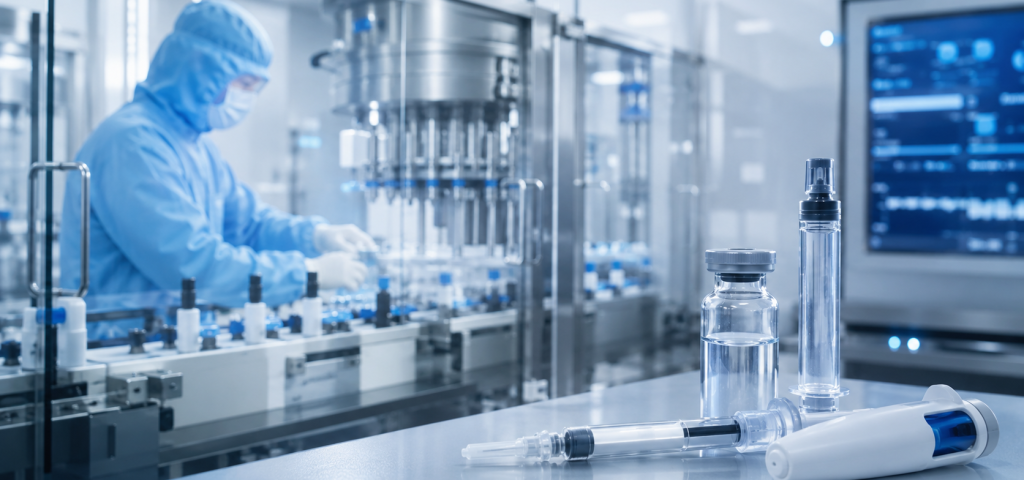
Adapted from an article originally published in ONDrug Delivery.
Sterile drug manufacturing is evolving rapidly. New therapeutic modalities, more patient-centric delivery formats and stricter regulatory expectations are reshaping how sterile products are developed, filled, monitored and scaled.
For pharmaceutical companies, these changes create important decisions early in the product lifecycle. The choice of delivery system, primary packaging, manufacturing technology and scale-up strategy can directly influence patient experience, regulatory readiness, commercial viability and long-term supply reliability.
For CDMOs, this means sterile manufacturing is no longer only about filling capacity. It requires the ability to combine technical expertise, contamination control, process understanding, digital monitoring and flexible manufacturing models to support customers from development through commercial production.
Patient-centric delivery is changing sterile product design
Patient centricity is now a defining factor in drug product design. For many chronic diseases, the goal is no longer only to develop an effective sterile product, but to make administration simpler, safer and more acceptable for patients outside the clinical setting.
This is one reason why prefilled syringes, autoinjectors and cartridge-based systems continue to gain importance. Single-injection systems can simplify administration and include built-in needle protection, while cartridge-based systems can support flexible dosing, particularly for therapies such as insulin or GLP-1 drugs. Some connected devices can also support reminders, dose tracking and feedback loops between patients and physicians.
However, delivery device selection is also a strategic decision. A more advanced or customised device can support differentiation, but it may also increase development complexity, cost and regulatory requirements. A standard platform device may reduce cost and accelerate development, but it can offer less differentiation and may lower future barriers for generic or biosimilar competition.
For pharma companies, these trade-offs should be considered early, alongside formulation, filling process, packaging compatibility and target market requirements.
Annex 1 has raised expectations for sterile manufacturing
The revised EU GMP Annex 1 has become a global reference point for sterile manufacturing. Its impact extends beyond Europe and applies across sterile product forms, including vials, prefilled syringes, cartridges and filled bags.
One of the most important shifts is the emphasis on a holistic contamination control strategy. Annex 1 requires manufacturers to think proactively about microbial, particulate, pyrogenic and chemical contamination risks. This places greater importance on advanced barrier technologies, such as isolators and restricted access barrier systems, as well as on minimising human intervention wherever possible.
But Annex 1 is not only a quality control topic. It requires cross-functional collaboration between quality control, quality assurance, production and engineering. A qualified cleanroom is no longer enough on its own. Sterile manufacturing now depends on a deeper process understanding, including airflow dynamics, barrier system integrity, environmental monitoring, aseptic behaviour and data-driven control.
For sponsors selecting a CDMO, this means inspection readiness should be assessed as a system, not as a single qualification or audit result.
Manufacturing models are becoming more flexible
Sterile manufacturing is also being shaped by a shift in materials and process technologies.
Single-use systems are increasingly used as an alternative to traditional stainless-steel equipment. They can reduce cleaning requirements, simplify changeover and lower cross-contamination risk. For certain products and batch sizes, they can improve flexibility and speed. However, they also require a strong understanding of material compatibility, extractables and leachables, and the environmental impact of increased waste.
Another trend is the increased use of pre-sterilised components, such as ready-to-use vials and stoppers. These can reduce set-up time and simplify operations, especially for smaller batches. For very large commercial quantities, in-house sterilisation may remain more cost-effective.
The right manufacturing model therefore depends on the product, batch size, lifecycle stage and commercial strategy. For sponsors, the key question is not whether a technology is modern, but whether it is appropriate, scalable and controlled for their specific product.
Digital monitoring and data integrity are becoming central to process control
Digitalisation is becoming a core part of sterile manufacturing performance. Process control and monitoring are increasingly performed in-line, with data captured directly into electronic batch records and supporting documentation.
This creates several advantages. It can improve data integrity, support faster verification, enable trend analysis and provide earlier visibility of process variability. Over time, this can strengthen process understanding and help manufacturers detect potential issues before they become deviations.
For pharma companies working with a CDMO, these capabilities are increasingly important. Robust digital systems can support transparency, inspection readiness and faster access to reliable manufacturing data.
Scale-up remains one of the highest-risk phases
Sterile scale-up can affect multiple product and process parameters. A process that performs well during development may face new constraints when batch volume, filling duration or holding time increases.
For temperature-sensitive products, larger batch volumes can increase processing time and create a higher risk of degradation. In some cases, jacketed vessels may be required to maintain the product at a controlled temperature over longer periods. Filling time can also increase significantly when moving from development to commercial scale, creating new challenges for maintaining product quality throughout the batch.
New modalities add further complexity. For example, autologous cell therapies may involve very small volumes, limited material availability and extremely short release timelines. Traditional batch approaches and sterility testing timelines may not be appropriate, which increases the need for rapid, compliant release strategies.
This makes early scale-up planning essential. The earlier sponsors and CDMOs align on process constraints, analytical needs, batch size assumptions and commercial requirements, the lower the risk of late-stage delays.
What pharma companies should expect from a sterile CDMO
As sterile products become more complex, CDMOs must be able to invest ahead of market needs while maintaining strong quality and regulatory discipline.
For pharma companies, the right sterile manufacturing partner should bring more than filling capacity. It should offer:
- strong contamination control expertise;
- experience with multiple sterile formats and delivery systems;
- a practical understanding of Annex 1 expectations;
- flexible manufacturing models for different batch sizes and lifecycle stages;
- digital process monitoring and reliable data integrity;
- scale-up expertise from development to commercial supply;
- and the ability to adapt quickly without compromising patient safety.
Speed matters in sterile manufacturing, but it cannot come at the expense of control. The next generation of sterile products will require manufacturing partners that can combine flexibility, technical depth and inspection-ready quality systems.
For sponsors, this means choosing a CDMO that is not only ready for today’s requirements, but prepared for where sterile drug manufacturing is going next.