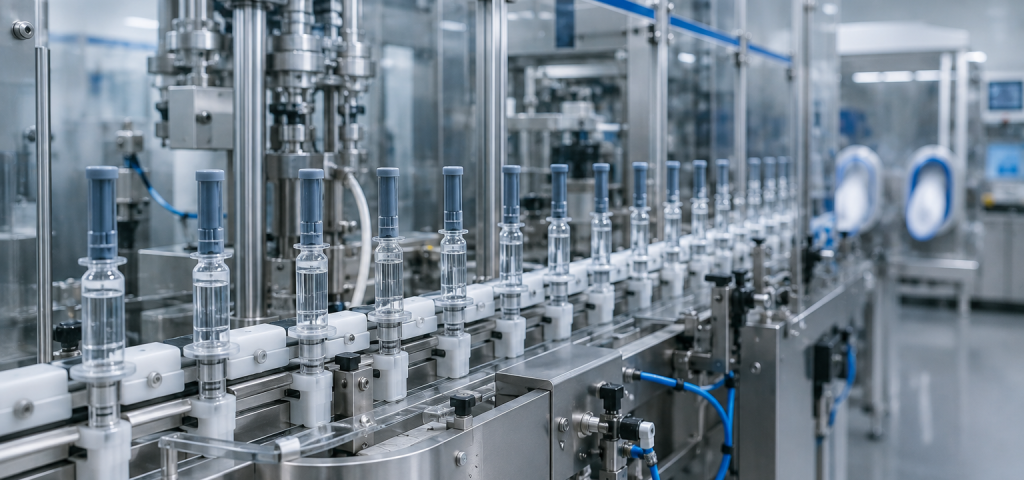
Commercial sterile injectable manufacturing is not only a production activity. It is a patient safety commitment, a quality system test, and a supply continuity challenge happening at the same time.
For pharma and biotech leaders, the most visible consequence of disruption is a delayed launch, missed supply window, or product shortage. The deeper cause is often a weakness in risk management across process robustness, sterility assurance, capacity planning, supplier readiness, or technical transfer.
In commercial sterile injectable manufacturing, small gaps become large risks. A formulation that behaved well in clinical batches may respond differently in larger vessels. A filling line that passed engineering runs may reveal intervention risks during longer commercial campaigns. A single-source stopper, syringe component, sterilising filter, or single-use assembly may become the constraint that delays patient supply.
Effective commercial sterile injectable manufacturing risk management means identifying these vulnerabilities early, testing assumptions before launch, and building a control strategy that can survive real operational pressure.
What are the biggest risks when scaling sterile injectable manufacturing from clinical to commercial production?
The biggest risks usually cluster into five areas: process robustness, sterility assurance, comparability, supply chain resilience, and site execution.
Clinical-to-commercial scale-up is not a simple increase in batch size. It often introduces different equipment, longer process times, new materials, revised hold conditions, new operators, commercial batch records, validated systems, and higher expectations for repeatability.
A clinical process can sometimes rely on close scientific supervision and manual flexibility. A commercial process must be executable, validated, documented, inspectable, and repeatable under routine manufacturing conditions.
Process behaviour may change at scale
One of the most common manufacturing scalability risks is that the process no longer behaves the same when moved from clinical to commercial scale.
Mixing dynamics can change. Temperature control may become less uniform. Larger volumes can increase hold-time exposure. Biologic formulations may be more sensitive to shear, oxygen exposure, light, freezing and thawing profiles, or adsorption to product-contact surfaces.
In sterile injectable manufacturing, fill-finish operations also become more demanding at scale. Filling accuracy may drift during long campaigns. Sterilising filtration performance can change with higher volumes or longer processing times. Lyophilisation cycles may not transfer cleanly between development dryers and commercial equipment.
The practical risk is clear: batch failure, lower yield, out-of-specification results, unexpected stability issues, or repeated deviations during process performance qualification.
Risk management starts with process characterisation. Critical quality attributes and critical process parameters must be understood before PPQ, not discovered during it. Hold-time studies, filter compatibility, mixing studies, line-speed trials, and lyophilisation cycle transfer assessments all help convert development knowledge into commercial control.
Sterility assurance becomes harder at commercial scale
Sterility assurance is one of the highest-risk areas in commercial sterile injectable manufacturing. Commercial scale can increase line complexity, campaign duration, personnel movement, material transfers, and aseptic interventions.
This does not mean contamination becomes inevitable. It means the contamination control strategy must be strong enough for the commercial reality.
Common weak points include non-representative media fills, incomplete airflow visualisation, inadequate transfer disinfection, insufficient oversight of aseptic behaviours, and environmental monitoring programmes that do not reflect true process risk.
Container-closure integrity is another critical part of sterility assurance. At commercial speed, stoppers can shift, crimps can vary, syringe functionality issues can emerge, and container-closure integrity testing may reveal failures after shipping stress or thermal cycling.
A robust contamination control strategy should connect facility design, isolator or RABS operation, personnel qualification, cleaning and sterilisation cycles, utilities such as WFI and clean steam, environmental monitoring, media fill design, and deviation trending.
GMP is a contract with patients. In sterile injectable production planning, sterility assurance must be treated as a lifecycle discipline, not a release test.
Comparability risk can delay approval or launch
Clinical-to-commercial scale-up almost always involves change. The site may change. Equipment may change. Component suppliers may change. Sterilising filters, filling needles, tubing sets, lyophilisation cycles, inspection methods, or container-closure systems may change.
Even when the formulation appears unchanged, these shifts can affect product quality attributes. For biologics and complex injectables, small differences in process conditions can influence potency, impurity profiles, aggregation, particulate matter, or stability.
The key question is not only whether the commercial product meets specification. The question is whether the commercial product is comparable to the clinical material used to generate safety and efficacy data.
This is where quality, regulatory, analytical, and manufacturing teams must work as one system. Analytical comparability, stability strategy, process validation, change control, and regulatory filing plans need to be aligned well before commercial launch.
Supplier and component risks are often underestimated
Supply chain disruptions in sterile injectables are frequently linked to components and materials rather than the drug substance alone.
Elastomer closures, glass vials, prefilled syringe components, sterilising filters, plungers, needles, trays, labels, single-use assemblies, and specialty excipients can all become bottlenecks. Lead times may be long. Supplier capacity may be constrained. Component changes may require technical assessment, regulatory evaluation, and additional testing.
At clinical scale, a manual workaround may be possible. At commercial scale, a late supplier issue can disrupt validation, delay PPQ, or force a filing change.
Capacity and vendor management should therefore begin early. A mature supply strategy includes supplier qualification, dual-source evaluation where feasible, quality agreements, forecast discipline, incoming quality controls, change notification expectations, and business continuity planning.
For sterile injectables, procurement is never just procurement. Component variability can become a quality event.
Tech transfer can fail even when the science is sound
Many scale-up failures are not caused by poor science. They are caused by weak operational translation.
A development report may describe the process, but the commercial site needs executable batch records, trained operators, validated recipes, defined sampling points, approved SOPs, qualified equipment, and clear escalation pathways.
Hidden operator knowledge is a common risk. If a step depends on judgement that has not been captured, trained, and controlled, it becomes fragile during commercial execution.
Effective tech transfer should include process walk-throughs, gap assessments, engineering runs, batch record simulations, operator training, deviation scenario planning, and quality oversight. The goal is not only to transfer information. The goal is to transfer control.
Human factors increase with throughput
Commercial manufacturing amplifies human-factor risk. More shifts, more interventions, more line clearances, more material movements, and more documentation steps create more opportunities for error.
Examples include component mix-ups, incorrect line clearance, visual inspection inconsistency, delayed escalation of environmental monitoring trends, or documentation errors that raise data integrity concerns.
This is where quality culture matters. Operators, engineers, analysts, QA reviewers, and supply chain planners need permission and expectation to escalate early. Healthy scepticism is valuable. A small atypical result, repeated minor intervention, or recurring equipment alarm may be the first signal of a larger trend.
ALCOA+ data integrity and good documentation practice are not administrative burdens. They are how the organisation proves what happened, when it happened, who performed it, and whether the process remained in control.
Problems will happen. The difference is discipline.
In commercial sterile injectable manufacturing, risk management does not mean pretending deviations will not occur. It means having a disciplined method for detection, triage, containment, investigation, CAPA, and effectiveness checks.
When an out-of-specification result, environmental excursion, sterility assurance concern, supplier nonconformance, or capacity constraint occurs, the response must be evidence-based.
Phase 1 and phase 2 investigations should be hypothesis-driven. Root cause analysis should distinguish between assignable cause, probable cause, and unresolved cause. CAPA should address the system weakness, not only the immediate symptom. Trending should connect events across batches, lines, suppliers, and shifts.
This is especially important for shortages. A rejected lot is not only a quality outcome. It may also be a patient access issue.
Closing
Commercial sterile injectable manufacturing risk management is the bridge between scientific promise and reliable patient supply.
The organisations that scale successfully do not rely on optimism. They prove that the product remains comparable, the process remains controlled, the container protects sterility and quality, and the commercial site can execute repeatedly.
Supply chain resilience in sterile injectables is built through quality discipline, capacity realism, supplier control, and a culture that escalates risk before it becomes a shortage.
